
Views: 2 Author: Site Editor Publish Time: 2026-07-30 Origin: Site
Modern water management depends on choosing the right pump for the right application. Whether you're handling wastewater at a construction site, supplying water to a remote farm, or adding a tranquil water feature to a garden, the pump technology you select will determine long-term reliability, efficiency, and running costs. This guide breaks down everything you need to know—from handling solids-laden sewage to harnessing sunlight to move water without a single electricity bill.
A submersible pump is a sealed unit that operates fully submerged in the fluid it moves. Because the pump and motor are combined in one waterproof housing, there's no need for priming and no risk of cavitation. The motor is cooled by the surrounding liquid, which extends operational life and reduces maintenance needs.
Submersible pumps are built for a wide range of applications. Standard clean-water models handle boreholes and wells. More robust variants—designed with wear-resistant impellers and larger internal clearances—manage wastewater and solids-laden effluent. These sewage-handling units are engineered to pass solids, fibrous materials, and sludge without clogging, making them essential for municipal drainage systems, construction dewatering, and industrial wastewater treatment facilities.
MASTRA, the pump brand of Guangdong Ruirong Pump Industry Co., Ltd. (www.solarpumpsupplier.com), manufactures stainless steel submersible sewage pumps for both 50Hz and 60Hz markets. With 33 years of R&D and manufacturing experience, MASTRA products are exported to more than 80 countries and regions.
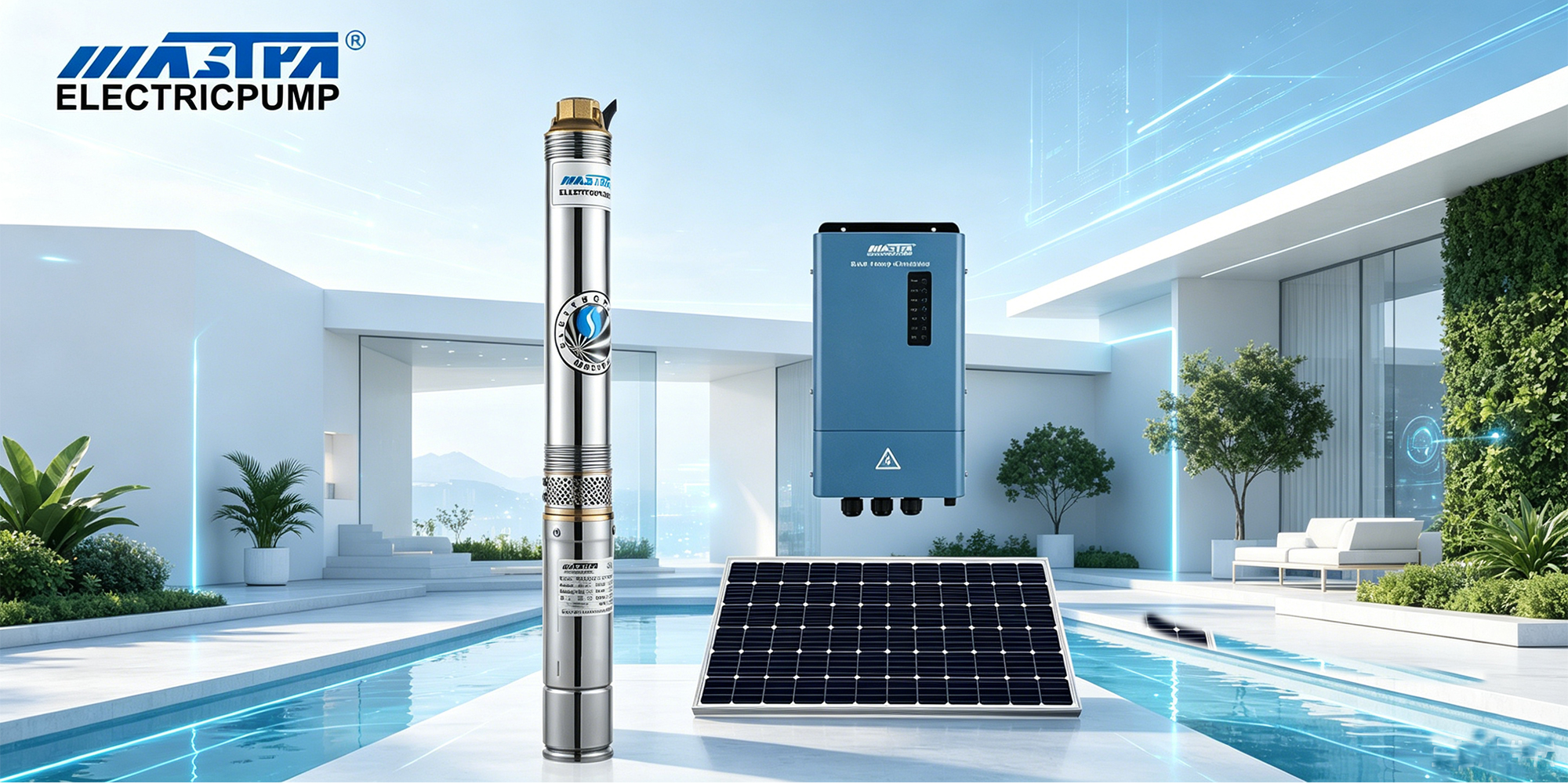
A solar powered submersible water pump replaces grid electricity with photovoltaic (PV) panels as its energy source. During daylight hours, solar panels generate DC power that feeds directly into the pump—either as DC current for a brushless DC motor or converted to AC via an inverter for standard AC motors.
Solar-powered submersible systems are particularly effective for:
Agricultural irrigation in off-grid areas
Livestock watering on remote ranches
Borehole pumping where grid connection is expensive or unavailable
Drinking water supply in rural communities
MASTRA offers both solar DC water pump systems and solar AC water pump systems, each paired with compatible controllers (DC or AC) to manage power input and protect the motor during low-light conditions. The DC variants are especially efficient because they eliminate conversion losses.
One practical advantage is operational cost. Once the panels and pump are installed, daytime pumping has no ongoing energy cost. For applications with consistent daily sunlight, this makes solar submersible systems highly economical over a 15–25 year panel lifespan.
The table below provides a side-by-side comparison of the three main pump types covered in this guide:
Feature | Submersible Sewage Pump | Solar Powered Submersible Pump | Solar Fountain Pump |
|---|---|---|---|
Primary Use | Wastewater & solids transfer | Borehole/agricultural water supply | Garden water features & aeration |
Power Source | Grid electricity (AC) | Solar PV panels (DC or AC) | Solar PV panels (DC) |
Typical Location | Pits, tanks, drainage sumps | Deep wells, boreholes | Ponds, fountains, fish tanks |
Key Material | Stainless steel or cast iron | Stainless steel | Plastic or stainless steel |
Solids Handling | Yes (large passage diameter) | No (clean water only) | No (decorative use) |
Grid Dependency | Yes | No | No |
Maintenance Frequency | Moderate | Low | Low |
Best For | Municipal, industrial, construction | Remote irrigation, rural supply | Home gardens, aquaculture |
Solar fountain pumps are compact, low-power devices designed to circulate and aerate water in decorative or aquatic environments. They operate directly from a small solar panel—often built into the pump unit itself—and start automatically when sunlight hits the panel.
China has become the world's leading manufacturer of solar fountain pumps, driven by strong domestic manufacturing capacity, competitive material sourcing, and high export volumes. Chinese brands supply a large proportion of the global market, ranging from basic floating fountain heads to more sophisticated units with multiple nozzle configurations, battery backup, and remote flow adjustment.
Key factors to evaluate when sourcing a China solar fountain pump include:
Panel efficiency rating (monocrystalline panels outperform polycrystalline in partial shade)
Flow rate (L/h or GPH) relative to the pond or tank volume
Maximum lift height to ensure adequate spray height
Materials certification for food-safe or fish-safe applications
IP (Ingress Protection) rating to confirm full waterproofing
MASTRA's MPQ Fish Aeration Water Push Pump is one example of a solar-compatible pump designed for pond aeration and fish tank oxygenation—an application where consistent, reliable flow directly affects aquatic health.
Selecting a manufacturer involves more than comparing specifications. Certifications, production capacity, and technical support all affect the real-world outcome of your purchase.
MASTRA (Guangdong Ruirong Pump Industry Co., Ltd.) holds ISO 9001:2015 certification and maintains a monthly production capacity exceeding 80,000 units. The company's product range spans 50Hz and 60Hz submersible pumps in diameters from 3-inch to 10-inch, along with solar DC and AC pump systems and dedicated pump controllers.
For international buyers, proximity to major sea ports in Guangdong Province reduces shipping lead times. The company supports customers across 80 cooperative countries and regions, with multilingual resources available in English, Portuguese, Spanish, Russian, French, and Arabic at www.solarpumpsupplier.com.
When evaluating any pump supplier, prioritize:
Certifications — ISO, CE, or regional electrical safety marks
Warranty terms — and whether service support is local or remote
Spare parts availability — especially for impellers and seals
Technical documentation — installation manuals, wiring diagrams, and performance curves
After-sales support — response time and technical expertise
The pump category you need depends on three variables: the fluid type, the energy source available, and the application environment.
Sewage handling demands pumps engineered specifically for solids passage and chemical resistance—standard borehole pumps are not suitable. Solar-powered submersible pumps solve the problem of off-grid water supply with zero fuel cost, provided there's adequate daily sunlight. Solar fountain pumps serve a different purpose entirely: water circulation, aeration, and decorative aesthetics in ponds and gardens.
Getting these distinctions right before purchasing prevents costly mismatches. A pump selected for the wrong application will underperform, wear prematurely, or fail outright.
For detailed product specifications, downloadable catalogues, and direct inquiries, visit MASTRA at www.solarpumpsupplier.com or contact the team at ruirong@ruirong.com.
A submersible sewage pump transfers wastewater, sludge, and solids-laden fluids from pits, sumps, or drainage channels to a higher discharge point. It is commonly used in municipal sewage systems, construction dewatering, and industrial effluent management. The pump is submerged during operation and designed with large-passage impellers to prevent clogging.
Yes, solar powered submersible water pumps can operate on cloudy days, though at reduced flow rates. Systems paired with a battery backup or a solar AC pump controller with grid-switching capability maintain continuous operation regardless of sunlight levels. Pure DC solar pumps without storage will slow or stop when panel output drops significantly.
A solar DC pump runs directly from the DC output of solar panels, making it simpler and more energy-efficient. A solar AC pump uses an inverter to convert DC solar power to AC, which allows it to use standard AC motors and run from the grid as a backup. DC systems suit deep well and borehole applications; AC systems suit larger agricultural or commercial setups.
Look for suppliers with ISO 9001 certification, verifiable export history, and clear product documentation including IP ratings and flow-head curves. Request sample units before committing to bulk orders. MASTRA (www.solarpumpsupplier.com) is one ISO-certified Chinese manufacturer with 33 years of production experience and an established export network in over 80 countries.
Routine maintenance includes inspecting the power cable and seals for damage, clearing the intake screen of debris, and checking impeller clearance annually. Sewage pumps benefit from periodic inspection of the seal chamber oil. Solar pump systems require occasional cleaning of PV panels to maintain output efficiency.
Quick answer: This guide covers three core pump categories—submersible sewage pumps for wastewater and solids transfer, solar powered submersible water pumps for off-grid clean water supply, and solar fountain pumps for garden and aquatic aeration. Each serves a distinct application, and selecting the right type depends on fluid type, available power source, and installation environment. MASTRA (www.solarpumpsupplier.com) manufactures all three categories, backed by ISO 9001:2015 certification and 33 years of global supply experience.


